
PPWR 2030: Is Your Cleaning Capacity Ready for 40% Reuse?
The PPWR has applied since 12 August 2026, and the first binding reuse targets for transport packaging follow in 2030. For companies working with pallets, crates, and containers, this is no distant prospect: those who invest in their cleaning process now will avoid it becoming the bottleneck of the entire reuse system in a few years’ time.
Much has already been written about tracking and data. Equally important, but discussed less often, is the question of what happens after every rotation: how is a load carrier made ready for use again quickly, reliably, and hygienically? In this article, we look at the PPWR from the shop-floor perspective.
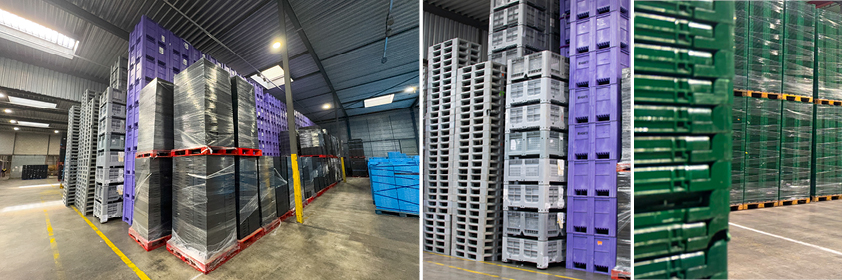
The PPWR at a glance: what applies when?
The regulation is being introduced in phases. The key milestones for companies with reusable transport packaging:
- 12 August 2026: the PPWR applies generally in all EU Member States.
- 2028: a harmonised material label should make separate collection easier.
- 2030: at least 40% of transport packaging, such as pallets, crates, trays, and containers, must be used within a reuse system. Exceptions apply to certain packaging types.
- 2040: the target is raised further to 70%.
More reuse means more wash cycles
It sounds logical, but the consequence is easily underestimated: every additional rotation of a crate, pallet, or container also means an additional cleaning cycle. If the share of reusable load carriers rises, the number of wash cycles rises by the same proportion.
A cleaning process that is perfectly adequate for a limited volume today may therefore reach its limit within a few years. This is especially true if the supply of dirty load carriers is uneven.
Where cleaning becomes a bottleneck
In a circular system, the cleaning step is the pivot between use and reuse. These are the places where things often get stuck:
- Peak loads: load carriers often return in waves, for example after a harvest peak or a promotional week. A machine designed for average volumes will fall behind.
- Turnaround time: the longer a load carrier waits for cleaning, the more assets you need to keep the chain running.
- Drying: wet load carriers cannot be reused straight away. A good drying step partly determines how quickly a crate or pallet can return to the chain.
- Hygiene and reproducibility: especially in the food industry, you must be able to demonstrate that every load carrier meets the same cleaning standard, even at high volumes.
- Water and energy consumption: more wash cycles mean higher consumption costs. An efficiently designed installation makes the difference here.
Clean in-house, outsource, or pool?
Not every organisation needs to build its own cleaning line. There are roughly three routes:
- Cleaning in-house: full control over quality and planning, suited to stable, high volumes.
- Outsourcing to a cleaning service provider: little investment, but you depend on someone else’s capacity and planning.
- Using a pool: assets are shared and cleaned by the pooling organisation. This shifts the capacity demand to the pool, which must then be able to scale up itself.
The route you choose depends on volume, the spread of your locations, and how much control you want to retain. For pooling companies and logistics service providers, making cleaning capacity scalable is often a direct prerequisite for growth.

Preparing for 2030 in five steps
- Map your current situation: how many load carriers do you clean per week, per peak day, and per year?
- Calculate what reuse means: what happens to those numbers if the share of reusable load carriers increases?
- Identify the bottlenecks: does the limitation lie in the washing step, the drying, the transport, or the supply?
- Look at the chain: which parties will clean what in the future, and where is there overlap or a gap?
- Choose a scalable solution: preferably a line that grows with your volume rather than a machine that needs replacing in two years.
The role of Numafa
A circular supply chain stands or falls with clean, ready-to-use load carriers. With our solutions for cleaning crates, pallets, and containers, complemented by drying, transport, and automation solutions, we help organisations scale up their cleaning process without compromising on hygiene and reliability.
Would you rather not make a large investment all at once? Then we will look together at whether a flexible option such as Clean Lease is a better fit. And because a machine only has value if it keeps running, our service specialists will advise on maintenance and spare parts, so your cleaning line remains available even at higher volumes.
Do you want to know whether your cleaning process is ready for the 2030 reuse targets? Get in touch with us, and we will review your volumes, your load carriers, and the best route together.
Back to overview
